


The first thing we would like to know about the model is its phase diagram, at least schematically. Suppose we consider the system in the absence of disorder, i.e. for V=0. Then the Hamiltonian is Gaussian, and we can calculate any expectation value easily. To do this, we go to momentum space

The Hamiltonian becomes

where we inserted a high-momentum cutoff  , which represents a
sort of inverse minimum bending length for the manifold. We can now
use the equipartition theorem to calculate
, which represents a
sort of inverse minimum bending length for the manifold. We can now
use the equipartition theorem to calculate

Note that the correlations are power-law in momentum (and in real space for d<2). Such power-law correlations indicate scale invariance. In fact, this Gaussian theory is a trivial example of a RG fixed point. We can see this explicitly by performing a simple ``momentum shell'' RG. The idea is to separate out modes with high momentum and then integrate those out of the theory, thereby deriving an effective theory for the low-momentum modes. Here this is trivial, because the Hamiltonian has decoupled into a sum over momenta. In equations, we first split up the field

where
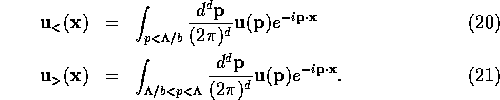
Then we can write

where b>1 is called the rescaling factor. Integrating out the  modes is then trivial, and we end up with just

where I have relabeled the field  .
Now this isn't quite the same form as we had before, because the
cutoff has changed from to
.
Now this isn't quite the same form as we had before, because the
cutoff has changed from to  . But we can
restore it by rescaling
. But we can
restore it by rescaling

It's worth noting that in real space, these rescalings look a bit different, owing to the integrals defining Fourier transforms:

After these rescalings,  is restored to the original form
of
is restored to the original form
of  . We have therefore shown that the theory is at a fixed
point.
. We have therefore shown that the theory is at a fixed
point.
I said earlier that the FP describing a phase should be absolutely
stable. That means if we perturb the Hamiltonian slightly, it should
be restored to the original form as the RG proceeds. When this is the
case, we say that the perturbation is irrelevant. If, on the
other hand, the perturbation actually grows under the RG, it is
relevant, and destabilizes the FP. In the pure case, the allowed
perturbations of are severely restricted by the requirement of
translational invariance  . This
requires all additional terms in H to have many gradients, e.g.
. This
requires all additional terms in H to have many gradients, e.g.

Using just the real-space rescaling portion of the RG, we see that

The mode integration has no effect on  , because it too
decouples into a mode sum. It can be shown that, although the mode
integration for
, because it too
decouples into a mode sum. It can be shown that, although the mode
integration for  is nontrivial, it is actually justified to
neglect its contribution to the renormalized Hamiltonian. Then the
rescaling (or ``power counting'') result above is correct. The powers
of b (
is nontrivial, it is actually justified to
neglect its contribution to the renormalized Hamiltonian. Then the
rescaling (or ``power counting'') result above is correct. The powers
of b (  and
and  ) are
known as RG eigenvalues. Because they are negative, both
perturbations are indeed irrelevant. This is true for any allowed
perturbation because of the extra gradients.
) are
known as RG eigenvalues. Because they are negative, both
perturbations are indeed irrelevant. This is true for any allowed
perturbation because of the extra gradients.
So we have identified a fixed point and shown its stability in the pure system. Let's call this the thermal fixed point, because the fluctuations of the manifold are entirely due to thermal noise. Does the associated thermal phase survive in the presence of disorder? To answer this question, we should see if the random potential V is a relevant or irrelevant perturbation.
Let's try and answer this question at the same level we just did for the higher gradient perturbations, i.e. not worrying too much about the nasty mode integration. We need to consider the term

Under rescaling, this becomes
It is not immediately apparent what to do with this, since the new rescaled Hamiltonian isn't just a constant multiplying the old Hamiltonian. The reason is that the disorder is really specified by a whole distribution, instead of a single parameter. We need to understand how the entire distribution rescales under the RG.
It IS possible to do this generally, but this turns out not to be so useful just now. Instead, let us restrict to the physical case of interest. For a narrowly distributed random potential, it is natural to describe the distribution in terms of its moments, the most important of which is just the variance. By translational invariance, this is a function

We would also like to consider short-range correlated potentials, in
which  decays rapidly as a function of both arguments. In
this case we can make an ``ultra-local'' expansion of in
terms of delta functions and their derivatives. This is equivalent to
making a Taylor series expansion in the conjugate variables for the
Fourier transform of . The leading term is then
decays rapidly as a function of both arguments. In
this case we can make an ``ultra-local'' expansion of in
terms of delta functions and their derivatives. This is equivalent to
making a Taylor series expansion in the conjugate variables for the
Fourier transform of . The leading term is then

Equation 32 tells us that the renormalized potential satisfies

Using the delta-function form for the correlations of V, we find

since 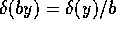 . If we iterate this rescaling
procedure, we get a recurrence relation. It looks particularly simple
if we then take the limit of infinitesimal rescaling, so that
. If we iterate this rescaling
procedure, we get a recurrence relation. It looks particularly simple
if we then take the limit of infinitesimal rescaling, so that  . Then we have a differential ``flow'' equation

The criterion that g is irrelevant is thus

PROBLEM: Show that when this is satisfied, all other random perturbations (i.e. higher moments and derivatives of delta-functions) are also irrelevant.

Figure 3: N-d ``phase diagram'' for random manifolds.
This specifies a curve in the N-d plane (see
Fig. 3). On one side the thermal phase is locally
stable. We see that this never occurs for domain walls, which
have N=1. For directed polymers, however, d=1 and the requirement
reduces to N>2. Interestingly, for N=2 and d=1, i.e. the
directed polymer in D=2+1=3 dimensions,  . When the
RG eigenvalue vanishes, we say that the perturbation is
marginal.
. When the
RG eigenvalue vanishes, we say that the perturbation is
marginal.
What happens in this case? Well, so far we have discussed a purely linear theory of the RG. This is usually adequate to understand the local stability near a FP, but fails when one of the RG eigenvalues vanishes at that point. In this case, we need to develop the quadratic correction to the RG flow for g. This correction comes entirely from the mode elimination step of the RG, which I have essentially neglected up to now. It is in fact much more work to calculate this correction, and I won't go into the details of how you do so. Instead, let's see how far we can get just by general arguments.
The next order term in the renormalization of g would arise
at second order in perturbation theory. Since we are only integrating
out short wavelength modes, we should expect it to be analytic. In
particular, there is no reason for the coefficient of  to vanish or be in any way singular near the line where
 vanishes. Thus we expect an RG equation of the
form
vanishes. Thus we expect an RG equation of the
form
The only important result that arises from a detailed calculation is that c>0. In fact, we could essentially rule out c<0 by various physical requirements, but I will just assume it and proceed.
Eq. 40 immediately answers our question. We
see that for , disorder still grows
under the rescaling. We say that it is marginally relevant.
This means that the thermal phase is unstable for the
2+1-dimensional directed polymer.
But let's not stop there. There is more to be learned from
Eq. 40. Consider small . Then there
is a regime  , when both the
linear and quadratic terms are comparable, but much smaller than the
neglected (
, when both the
linear and quadratic terms are comparable, but much smaller than the
neglected (  ) corrections. We then find that for
 , there is a new fixed point, for
  , which is unstable. This is then a critical fixed
point, separating the thermal phase from some non-thermal phase, which
occurs for stronger disorder. As
, which is unstable. This is then a critical fixed
point, separating the thermal phase from some non-thermal phase, which
occurs for stronger disorder. As  , this
fixed point moves into the origin, and the flows become unstable
everywhere for
, this
fixed point moves into the origin, and the flows become unstable
everywhere for  .
.
The implication is that a disorder-dominated phase exists for any d and N. For some range of d and N, if the disorder is weak enough, the thermal phase continues to exist, but inevitably undergoes a transition to the disorder-dominated phase as the randomness is increased. In fact, the existence of a phase transition has been rigorously proven for N>2 and d=1, using the same kind of methods Marc described for the Sherrington-Kirkpatrick model[5]. By rough analogy to the bulk phases of the magnet we discussed earlier, the thermal fixed point describes the high-temperature phase of the system, where entropy and not energy is the dominant source of fluctuations. The strong disorder phase is presumably energy dominated, and we might guess that it is an ordered phase described by a zero-temperature fixed point. This is certainly consistent with the finding that g flows to strong coupling in this phase.
To really address this scenario, we need to consider the nature of the T=0 state of the random manifold. The stability of the zero temperature fixed point is addressed like any other fixed point, by determining the RG eigenvalue of temperature. It is conventional to write

where  is the eigenvalue of temperature. For the
ordered phase to be stable, we need
is the eigenvalue of temperature. For the
ordered phase to be stable, we need  .
.

