


For completeness, I will summarize the structure of the RG treatment in two dimensions. The interested reader is encouraged to check the literature for discussions of alternative approaches and the various controversial points. The marginality of temperature in this case leads to the formation of a finite temperature fixed line instead of the usual isolated T=0 fixed point. The RG has been studied quite some time ago by Cardy and Ostlund. There are both complications and simplifications over the d>2 case.
First, we may no longer ignore the  term, which is itself
marginal in two dimensions. This of course complicates the analysis.
However, because one is working at finite temperature, it turns out to
be possible to keep only the first harmonic in a Fourier expansion of
term, which is itself
marginal in two dimensions. This of course complicates the analysis.
However, because one is working at finite temperature, it turns out to
be possible to keep only the first harmonic in a Fourier expansion of
 , i.e.

Likewise, we may decompose

where  is a traceless matrix. Only
  plays an important
role in the RG. The Cardy-Ostlund analysis gives
plays an important
role in the RG. The Cardy-Ostlund analysis gives
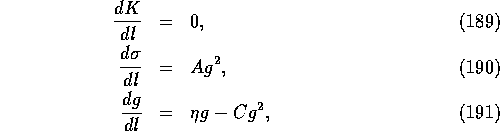
where A and C are cut-off dependent, but  , and
, and

Here we have kept T fixed, as is appropriate for a finite temperature fixed line.
For  , i.e.
 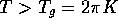 , the system is in a thermal
phase, and the disorder g flows to zero. A residual finite value of
leads to some small distortions of the phase.
, the system is in a thermal
phase, and the disorder g flows to zero. A residual finite value of
leads to some small distortions of the phase.
For  , the system is in a glassy phase. For small
  , the
RG is controlled and g flows to a fixed point
, the
RG is controlled and g flows to a fixed point  .
The vector field then grows without bound. This,
however, can be shown not to invalidate the RG, and leads only to a
large, scale-dependent ``background'' distortion of phase. It is this
background distortion that shows up as the
.
The vector field then grows without bound. This,
however, can be shown not to invalidate the RG, and leads only to a
large, scale-dependent ``background'' distortion of phase. It is this
background distortion that shows up as the  growth of phase
fluctuations.
growth of phase
fluctuations.
Some nice extensions of the RG to calculate other quantities are described in T. Hwa and D. S. Fisher, PRL 72, 2466 (1994).